Key Takeaways
- B2B marketing funnels fail when they treat every lead equally — only 5-15% of leads in a typical funnel are actually ready to engage with sales
- Traditional qualification frameworks (BANT, CHAMP) rely on information prospects tell you. Intent-based qualification uses data about what they actually do
- Longer B2B sales cycles and multi-person buying committees make timing the critical factor — reaching a company during active evaluation yields 3-5x higher conversion rates
- This guide covers how to qualify B2B leads using real-time search behavior, so your sales team talks only to accounts showing genuine buying signals
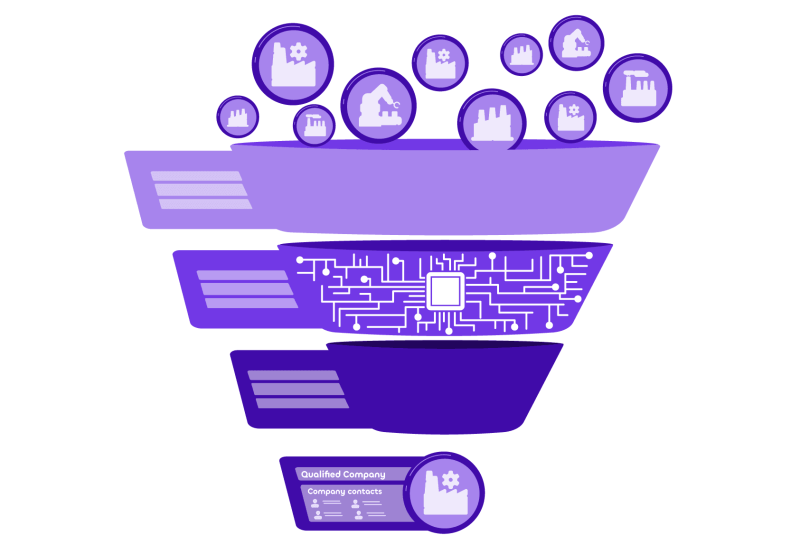
Your B2B marketing funnel generates leads. That’s not the problem. The problem is that most of those leads never become customers.
The numbers are sobering. According to Forrester, less than 1% of B2B leads typically convert to revenue. Not because the leads are bad — but because they enter the funnel at different stages of readiness, and most teams can’t tell the difference.
B2B lead qualification is the process of determining which accounts in your funnel are genuinely close to a buying decision. Done well, it focuses your sales resources where they’ll actually convert. Done poorly — or not done at all — it turns your pipeline into an expensive list of companies that aren’t ready to talk.
Why B2B Lead Qualification Is Harder Than B2C
Before diving into methods, it helps to understand why qualifying leads in B2B is fundamentally different from B2C. Two structural factors make it more complex.
Multi-Person Buying Committees
In B2C, one person decides and buys. In B2B, purchasing decisions involve 6-10 stakeholders on average, according to Gartner. Each has different priorities — the CFO cares about ROI, the IT director cares about integration, the end user cares about usability.
This means a single contact downloading your whitepaper doesn’t indicate that the company is qualified. It indicates that one person inside the company showed some interest. The other five to nine haven’t weighed in yet.
Extended Sales Cycles
B2B sales cycles run 3-12 months, sometimes longer. The buying committee goes through problem definition, internal alignment, vendor scouting, evaluation, approval, and negotiation before signing anything.
A lead that looks promising in January might not make a decision until September. If your sales team treats every inbound lead as urgent, they burn cycles on companies that are months away from being ready — while missing companies that are evaluating right now.
The Problem with Traditional Qualification Methods
Most B2B teams use one of several established frameworks to qualify leads:
- BANT (Budget, Authority, Need, Timing) — the classic framework where you assess whether a prospect has the budget, decision-making authority, a genuine need, and a timeline
- CHAMP (Challenges, Authority, Money, Prioritization) — similar to BANT but prioritizes understanding the customer’s challenges first
- MEDDIC (Metrics, Economic Buyer, Decision Criteria, Decision Process, Identify Pain, Champion) — a more structured approach common in enterprise sales
These frameworks are useful, but they share a fundamental limitation: they require the prospect to tell you things. You need them to answer questions about budget, timeline, and decision-making authority. That only works when the prospect is already engaged with you.
What about the 67% of the buying journey that happens before a prospect contacts sales? That’s the invisible majority of the qualification picture — and traditional frameworks can’t see it.
How Intent Data Changes B2B Lead Qualification
Intent data fills the gap that traditional frameworks miss. Instead of asking prospects where they are in the buying process, you observe it through their online behavior.
When a company’s employees search for solutions in your category — comparing vendors, reading implementation guides, looking up pricing — they’re creating a data trail that reveals their position in the buying journey.
Here’s what makes this approach different from standard lead scoring:
- It’s behavioral, not declarative. You’re reading what companies do, not what they say they’ll do. Actions are more reliable than survey responses
- It captures committee-level activity. When multiple people at the same company search for related topics, it signals that the buying committee has activated — one of the strongest predictors of a near-term purchase
- It works in real time. Search behavior changes daily. A company that was in early research last month may have shifted to active evaluation this week. Traditional scoring models update too slowly to catch this
A Practical Framework for Intent-Based Lead Qualification
Here’s how to build lead qualification powered by intent signals into your B2B marketing funnel.
Step 1: Define What “Qualified” Means for Your Business
Before you can qualify leads, you need clear criteria. Most B2B companies use two qualification tiers:
- Marketing Qualified Lead (MQL): Fits your ideal customer profile + has engaged with your content or campaigns
- Sales Qualified Lead (SQL): MQL criteria + shows active buying signals (intent data showing evaluation-stage behavior)
The transition from MQL to SQL is where intent data adds the most value. An MQL tells you a company could be a good fit. An SQL tells you they’re actively looking.
Step 2: Map Search Behavior to Funnel Stages
Not all search behavior indicates the same level of readiness. Create a classification that maps what companies search to where they likely sit in your funnel:
- Top of funnel (Awareness): Broad category searches — “what is account-based marketing,” “how to reduce ad waste.” These indicate problem awareness but not solution evaluation
- Middle of funnel (Consideration): Solution comparisons, feature searches, “best [category] for [industry].” These indicate the company is actively comparing options
- Bottom of funnel (Decision): Pricing queries, implementation guides, vendor-specific searches, “CRM integration with [tool].” These indicate a near-term purchase decision
Tools like Vehnta’s Search Terms feature let you see exactly what your target accounts are searching for, mapped to these stages in real time.
Step 3: Score Leads Based on Behavioral Signals
Combine intent data with traditional firmographic fit to create a scoring model that prioritizes accounts most likely to convert:
- High score: Fits ICP + decision-stage search behavior + multiple people searching + activity in the last 7 days. Route directly to sales for immediate outreach
- Medium score: Fits ICP + consideration-stage search behavior + single searcher + activity in the last 30 days. Nurture with targeted content, monitor for escalation
- Low score: Fits ICP + awareness-stage behavior or no recent search activity. Keep in marketing nurture programs. Don’t send to sales yet
This model prevents the most common qualification failure: sending leads to sales too early. When a sales rep receives only high-score accounts, their close rate improves because every conversation is with a company that’s actually evaluating solutions.
Step 4: Automate the Handoff
Qualification only works if the handoff from marketing to sales is fast and seamless. When an account’s score crosses from medium to high:
- The sales rep should be notified within hours, not days
- The notification should include context: what the company has been searching for, how frequently, and from which locations
- First outreach should reference the company’s industry challenges (informed by their search behavior) rather than a generic pitch
This is where Vehnta’s Insight Collection drives efficiency: converting raw search data into actionable intelligence that tells your sales team exactly when and why to reach out to a specific account.
How Qualification Impacts Funnel Performance
The benefits of proper lead qualification compound across your entire funnel:
- Sales efficiency increases: Reps spend time on accounts that are actually evaluating, not chasing companies that downloaded a whitepaper out of curiosity
- Conversion rates improve: When you engage companies during their active evaluation window, the likelihood of closing increases significantly — companies evaluating vendors respond to relevant outreach at 3-5x the rate of cold prospects
- Sales cycle length decreases: By identifying companies that are already partway through their buying journey, you enter the conversation further down the funnel. Less education needed, faster decision
- Marketing-sales alignment improves: When both teams agree on what “qualified” means — and intent data provides an objective measure — the friction between marketing (“we sent you leads”) and sales (“those leads were garbage”) disappears
What to Avoid: Qualification Mistakes That Kill Your Funnel
Three mistakes that undermine even well-designed qualification systems:
Mistake 1: Over-qualifying. If your criteria are too strict, good prospects get stuck in nurture programs when they should be talking to sales. Review your qualification thresholds quarterly — if less than 20% of MQLs become SQLs, your thresholds are too aggressive.
Mistake 2: Ignoring negative signals. Qualification isn’t just about finding ready-to-buy accounts. It’s also about identifying companies that are not qualified — wrong industry, wrong size, or no buying authority — and removing them from the sales pipeline before they waste resources.
Mistake 3: Static scoring. B2B buying behavior changes over time. A company that scored “low” three months ago might be in active evaluation today. Your qualification model needs to update continuously based on fresh behavioral data, not rely on a snapshot from the initial interaction.
The Bottom Line: Qualify by What Companies Do, Not What They Say
B2B marketing funnel performance isn’t about generating more leads. It’s about identifying which leads are worth your sales team’s time — and reaching them when they’re most ready to engage.
Traditional qualification frameworks tell you whether a prospect could be a good customer. Intent data tells you whether they’re acting like one right now. The companies that show decision-stage search behavior, activated buying committees, and recent research spikes are the ones your sales team should be calling today.
The funnel doesn’t need more leads. It needs better filters. And the best filter is real-time data about what your target accounts are actually doing.